
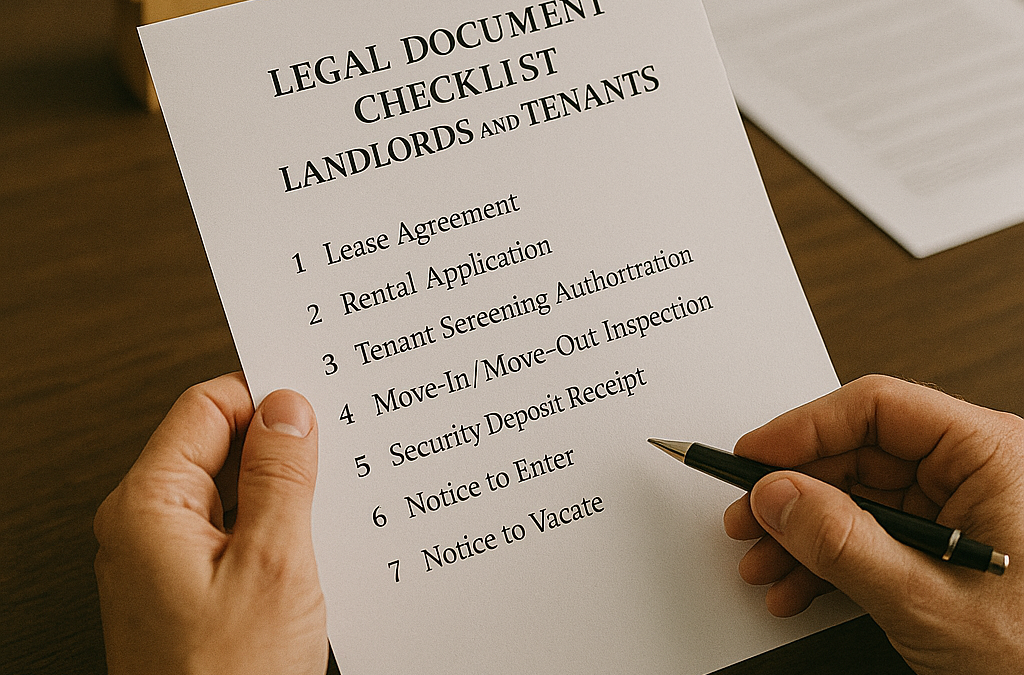
Every lease tells a story, but the plot only holds together when the paperwork does. Whether you’re handing over keys or picking them up, the landlord-tenant relationship is built on documents that clarify expectations, allocate responsibilities, and keep both sides compliant with the law. In an era of e-signatures, shifting regulations, and fast-moving rental markets, knowing which forms you need-and when-can be the difference between a smooth tenancy and a costly misunderstanding.
This introduction sets the stage for a practical, plain‑English checklist of the essential legal documents that anchor a rental from move‑in to move‑out. We’ll highlight what belongs in a lease, which disclosures are commonly required, how to document inspections and deposits, and what notices to have ready for routine changes or disputes. You’ll also see where addenda, guarantor agreements, and fair housing considerations fit into the file, and how to keep records that stand up to scrutiny.
While specifics vary by jurisdiction, the core principles are consistent: clarity, completeness, and timely communication. Consider this your roadmap to a well‑documented tenancy-reassuring for landlords, empowering for tenants, and useful for anyone who wants fewer surprises after the ink dries.
Core Lease Elements and Protective Clauses with Sample Language to Reduce Risk
Build a resilient agreement by capturing the essentials up front and writing them with precision. Include:
- Parties & Premises – Full legal names/entities and exact address (unit, parking, storage).
- Term & Renewal – Fixed start/end dates, renewal method, and holdover treatment.
- Rent & Deposits – Amount, due date, grace period, late/NSF fees, deposit sum and accounting.
- Use & Occupancy – Permitted use, guest limits, home-business rules, pet policy.
- Utilities & Services – Who pays what; allocation method; trash, snow, landscaping.
- Maintenance – Landlord vs. tenant duties, response standards, reporting timelines.
- Entry & Notice – Notice hours/days, emergency access, permitted notice methods.
- Insurance – Required tenant liability coverage and proof schedule.
- Default & Remedies – What triggers breach, cure periods, and consequences.
- Legal – Governing law, venue, severability, entire agreement, e-signatures.
Reinforce those foundations with concise, plain‑English provisions that set expectations and encourage compliance. Adapt the examples below to your jurisdiction and property type.
| Provision | Sample language |
|---|---|
| Late Fee | “If rent is not received by 5:00 p.m. on the 5th, Tenant pays a late fee of $50 or 5%, as permitted by law.” |
| Payment Allocation | “Payments apply to fees, then past due rent, then current rent.” |
| Security Deposit | “Deposit may cover unpaid rent and damage beyond ordinary wear; itemized statement within 21 days.” |
| Maintenance Notice | “Tenant will report leaks, loss of heat, or safety issues within 24 hours.” |
| Access | “Landlord may enter with 24‑hour notice for repairs, inspections, or showings; immediate entry for emergencies.” |
| Alterations | “No alterations without prior written consent; approved work becomes Landlord’s property.” |
| Assignment/Sublet | “No assignment or subletting without prior written consent; consent will not be unreasonably withheld.” |
| Early Termination | “Upon [trigger], either party may terminate with 30 days’ notice and a $500 early termination fee.” |
| Holdover | “Holdover creates month‑to‑month at 150% of last monthly rent.” |
| Insurance | “Tenant maintains $100,000 liability coverage and provides proof annually.” |
| Indemnity | “Tenant indemnifies Landlord for claims arising from Tenant’s negligence.” |
| Dispute Process | “Parties will negotiate in good faith for 10 days, then mediate before filing suit.” |
| Attorney Fees | “Prevailing party may recover reasonable attorneys’ fees, as allowed by law.” |
| Nonwaiver | “Failure to enforce any term is not a waiver of future enforcement.” |
| Severability | “If any term is invalid, the remainder stays in effect.” |
Mandatory Disclosures Property Condition Reports and Local Compliance Checkpoints
Before keys change hands, compile the non-negotiable notices your jurisdiction demands and align them with your lease. Each item should have a clear trigger (year built, local hazard maps, utility configuration), a delivery point (pre‑lease, at signing), and a signed acknowledgement you retain. Use plain language, attach maps or addenda where required, and timestamp delivery (e-signatures are acceptable in most regions). When in doubt, include the notice and label it “for informational purposes” rather than omit it-silence creates liability.
- Lead-Based Paint: Homes built before 1978; EPA brochure + disclosure.
- Environmental & Hazard Zones: Flood, wildfire, seismic, radon or airport noise where mapped.
- Mold/Moisture & Pest History: Past or present conditions and remediation steps.
- Utility Allocation: Ratio billing/shared meters; fees and reading method.
- Local Program Notices: Rent caps, eviction controls, rental registry or license numbers.
- Property Rules: Smoking, pet/assistance animals, parking, and HOA constraints.
- Monitoring Disclosure: Cameras in common areas; no audio in private spaces.
- Communication Consent: Email/text delivery of notices if permitted.
| Checkpoint | Proof to Keep | Renewal |
|---|---|---|
| Rental Registration/License | Certificate + number in lease | Annual or per term |
| Certificate of Occupancy | Issued CO/inspection sign-off | On change of use/major work |
| Life-Safety Devices | Photo of installed smoke/CO | Test at move-in; semiannual |
| Water Heater Seismic Strap | Photo + installer receipt | After replacement |
| GFCI/Egress/Guardrails | Inspector checklist | At inspection/turnover |
Document the home’s baseline condition with a move‑in report that is specific, media‑rich, and co-signed. Use a room‑by‑room grid, embed date‑stamped photos/video, and record serial numbers, meter readings, and key/remote counts. Deliver a copy within the timeline required locally, invite tenant comments, and finalize a combined version. At move‑out, repeat the process against the baseline to fairly separate ordinary wear from chargeable damage. Pair this with a simple compliance calendar so safety checks and municipal renewals never lapse.
- Include: Walls/floors, windows/screens, appliances, fixtures, drains, alarms.
- Rate: New / Good / Worn; note defects and pending repairs.
- Attach: 2-4 photos per area; video walkthrough link.
- Log: Water, gas, electric meters; mailbox/parking identifiers.
- Sign: Landlord and tenant; share via e-sign; store securely.
Screening Documentation Privacy Rules and Fair Housing Proof You Should Keep
Treat screening records like currency. Collect only what you need, capture written consent to run credit/background checks, and practice data minimization (mask SSNs to last four, avoid storing full ID images unless required). Lock down access with role-based controls, maintain an access log (who viewed, when, and why), and use encryption at rest and in transit-never email raw reports. Publish a clear, dated screening criteria sheet and apply it consistently. Create a retention schedule (for example, commonly 3 years after decision, longer if your jurisdiction or insurer requires), then securely delete on schedule with shredding/wiping and a simple destruction log. Keep vendor agreements and attestations from screening providers that confirm compliant handling, and document your incident response steps in case of a data breach.
Proof of fair, consistent treatment is your best ally. Archive time-stamped listings, a unit availability log, the exact criteria version in effect, and a complete application queue showing order received. Keep adverse action notices with concise, permissible reason codes, plus records of the interactive process for accommodation/modification requests and their outcomes. Save staff training certificates, office policies, and change history so you can show what rules applied to whom and when. Pair each decision with supporting documentation-and omit protected-class details that aren’t relevant-to demonstrate that judgments flowed from neutral criteria rather than prohibited factors.
- Screening criteria sheet: Dated, versioned, and posted to applicants.
- Applicant consent & disclosures: Signed forms authorizing checks and data use.
- Adverse action templates: Pre-filled with lawful reason codes and delivery proof.
- Access log: Who opened reports, purpose, and timestamp.
- Data retention map: Where data lives, how long it stays, and deletion method.
- Accommodation file: Requests, communications, decisions, and effective dates.
- Marketing archive: Screenshots/PDFs of ads, eligibility language, and dates.
| Document | Keep How Long | Store Where | Note |
|---|---|---|---|
| Applications (all outcomes) | 3 years after decision | Encrypted PMS/drive | Mask SSNs |
| Credit/Background reports | Short as possible (≤ 2 years) | Restricted vault | No email storage |
| Adverse action notices | 3-5 years | Tenant file | Include reason codes |
| Criteria (version history) | 5 years | Policy library | Timestamp updates |
| Accommodation records | 4-5 years | Separate, access-limited | Document interactive steps |
| Marketing & availability logs | 3-5 years | Read-only archive | Time-stamp entries |
Move In Move Out Records Maintenance Requests and Evidence Preservation Tips
Build a defensible timeline from first key handover to final walkthrough. Pair a standardized Condition Report with annotated photo/video evidence to fix the unit’s baseline-capture walls, floors, ceilings, doors, windows, appliances, fixtures, alarms, meters, and exterior. Use time-stamped images, include room labels and close-ups of wear, and collect signatures (physical or e-sign) on the same day. Name files consistently (e.g., 2025-04-Unit3A-MoveIn-Photos) and store them in organized folders alongside keys/meter logs, inventory lists, and accessory checklists. At move-out, mirror the process, compare side-by-side with move-in, and attach invoices/quotes for any claim to make deposit accounting verifiable.
- Must-have artifacts: Condition report, photo/video set, key receipt, meter readings, appliance serials, paint codes.
- Walkthrough protocol: Two-person verification, date/time on paper, note odors/noise/pests, test smoke/CO alarms.
- Fair wear vs. damage: Use written standards with examples; avoid subjective terms without evidence.
- Communications trail: Keep confirmation emails/texts for showings, handovers, and notices.
| Document | Who Signs | Format | Keep For |
|---|---|---|---|
| Move-in condition report | Both | PDF + photos | 3-7 yrs (local law) |
| Photo/video set | N/A | JPEG/MP4 | Lease + 3 yrs |
| Key receipt | Both | Lease term | |
| Move-out inspection | Both | PDF + photos | 3-7 yrs |
| Deposit accounting | Landlord | PDF + invoices | Statute limit |
Treat maintenance like evidence management. Centralize requests in writing (portal/email form), auto-assign a ticket number, and log date received, response time, vendor, photos, and outcome. For emergencies, accept calls but send a written follow-up recap. Keep work orders, estimates, receipts, warranties, permits, and vendor insurance/W-9 together with the ticket. Preserve original files, export PDF/A versions for longevity, run periodic backups, and apply a simple retention schedule. If litigation is likely, place a legal hold, stop deletion, and document chain-of-custody for physical items (e.g., damaged parts) with labeled bagging and storage.
- Template fields: Who reported, unit, issue category, hazard level, photos/video, access granted, resolution, costs.
- Naming tip: YYYY-MM-DD-Property-Unit-Ticket#-Issue (e.g., 2025-05-02-Maple-2B-1147-Leak).
- Data hygiene: Keep originals unedited; create a redacted copy for sharing; note edits in a change log.
- Proof of notice: Use read receipts, tenant portal acknowledgments, or certified mail for critical notices.
To Conclude
Orderly paperwork won’t turn a bad rental into a good one, but it does turn uncertainty into clarity. Treat this checklist as a living map: revisit it before you list a unit, at move-in, at renewal, and when a tenancy ends. Make sure every document is dated, signed, and stored in at least two places, with proof of delivery where required. When laws change-or when a dispute teaches you something new-update the set.
Because requirements vary by jurisdiction and property type, adapt the checklist to local rules and the specifics of your agreement. Templates are helpful starting points, not substitutes for legal advice; consult a qualified professional if you’re unsure about any clause or notice.
In the end, the goal is simple: a record that speaks clearly when you need it most. With the right documents in the right order, both landlords and tenants can spend less time untangling questions and more time keeping the tenancy steady, lawful, and predictable.