

Paper travels more than people do. A power of attorney signed in Arizona may need to open a bank account in Pennsylvania; a court order issued in Ohio might be presented to a school in Florida. But when documents cross state lines, they pass through a patchwork of rules, offices, and expectations-raising a simple question with a surprisingly technical answer: how do you verify that a document is legally valid somewhere else?
Verifying “legality” across states isn’t a single test; it’s a set of checks. It can mean confirming authenticity (Is this the real document?), execution (Was it signed, witnessed, or notarized correctly under the governing state’s rules?), and recognition (Will another state accept it as-is, or does it need additional steps?). Sometimes the proof lives on a raised seal or a clerk’s stamp; sometimes it’s embedded in a digital certificate. The right checkpoint may be a county recorder, a Secretary of State, a court, a licensing board, or a secure online registry.
This article maps that terrain. It explains how to decode seals and signatures, where to verify records, when certifications or “certificates of authority” are needed, how interstate recognition works for judgments and vital records, and what to look for with e-signatures and remote notarization. The goal is simple: to give you a clear, practical path for confirming that a document can do its job-no matter which side of a state line it lands on.
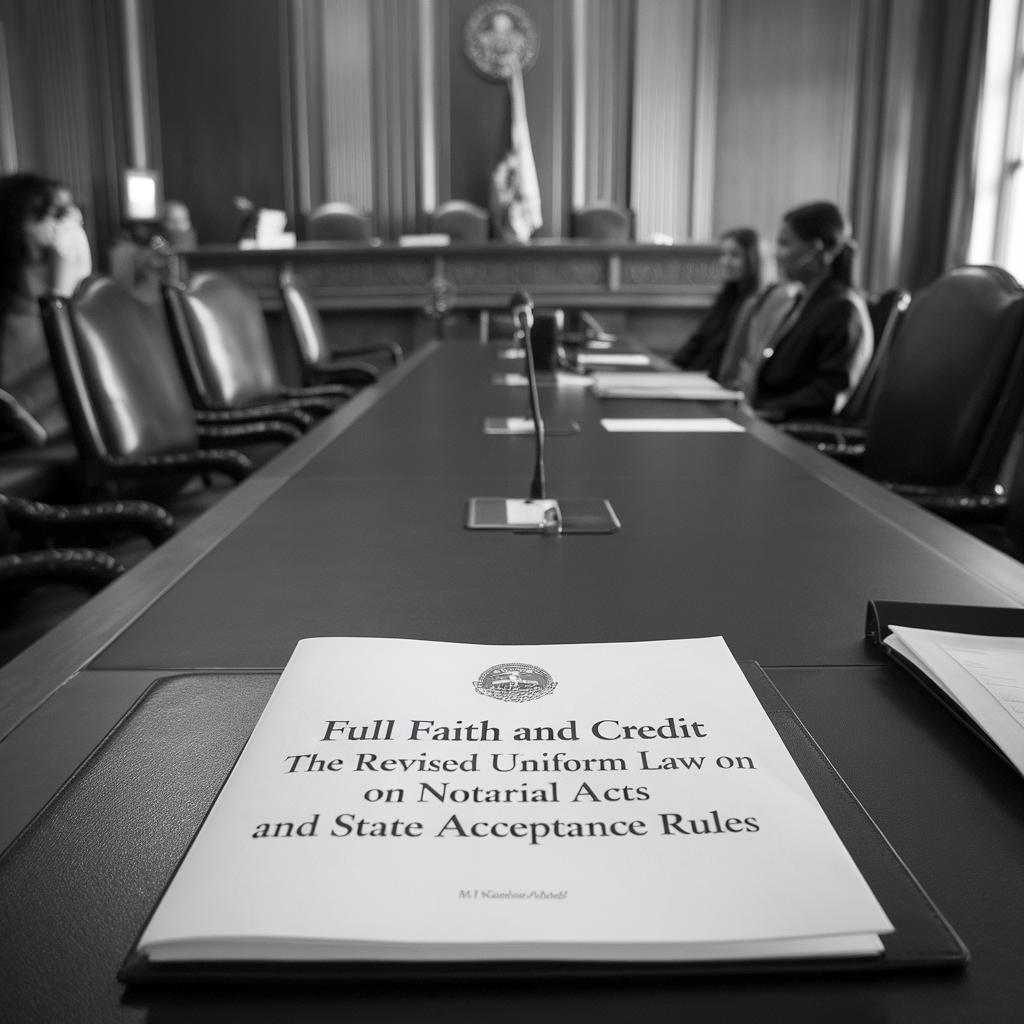
Understanding the legal backbone Full Faith and Credit the Revised Uniform Law on Notarial Acts and state acceptance rules
Full Faith and Credit obligates states to respect each other’s judicial proceedings most rigorously-final judgments travel well and are rarely second-guessed except for jurisdictional defects-while “public acts and records” get strong, but not absolute, deference. That means a marriage certificate, corporate filing, or notarized affidavit valid in the issuing state is generally recognized elsewhere, yet the receiving state can still apply its own procedural and public policy rules (think filing formats, recording standards, or consumer-protection overlays). In practice, interstate legality often turns on two questions: Was the document valid where created, and does the receiving state have a compelling reason to require something more?
The Revised Uniform Law on Notarial Acts (RULONA) supplies the common grammar for recognition by defining who may notarize, what a proper certificate looks like, and how out‑of‑state acts are accepted-including growing provisions for remote online notarization (RON). Many states have adopted RULONA (some with tweaks), so a compliant notarization in State A typically has the same effect in State B. Still, acceptance rules vary at the edges: certain offices expect specific certificate wording, a legible seal, a venue line, or evidence that a RON was performed on an authorized platform with tamper‑evident tech. In short, RULONA smooths the path, while each state’s receiving office decides the last mile.
- Confirm the source: Identify the state, the notarial officer’s title, and whether the act was in‑person or RON.
- Match the certificate: Look for venue, date, signer’s name, officer’s signature, title, and seal (ink or digital) that meet the issuing state’s rules.
- Check receiving-office quirks: County recorders often require margins, font sizes, legibility, and specific acknowledgment language.
- Remote notarization? Verify the platform’s authorization, audiovisual retention, and tamper‑evident formatting if the receiving state expects it.
- Substantial compliance: Many RULONA states accept minor variances if the certificate clearly proves the act’s validity.
- When in doubt: Ask the clerk or recorder for a sample certificate-meeting their template avoids avoidable rejections.
| Document | Default Interstate Recognition | Typical Extra Demands |
|---|---|---|
| Court judgment | Strong under Full Faith and Credit | Proof of jurisdiction; certified copy |
| Notarized contract | Recognized if valid where notarized | Exact acknowledgment wording; clear seal |
| Real property deed | Generally accepted | Recorder formatting and local form preferences |
| Power of attorney | Widely honored | Statutory form in some states; witness rules |
| RON document | Increasingly accepted | Authorized platform; tamper‑evident certificate |

Pinpointing the right authority Secretaries of State county recorders and court clerks by document type
Choosing the right desk saves days: think in terms of who created, recorded, or certified the record. The Secretary of State is the hub for business entities, UCC filings, notary commissions, and state-level apostilles/authentications on documents issued or notarized in that state. The County Recorder maintains real property instruments-deeds, liens, plats-and proves what’s officially recorded against a parcel. The Court Clerk is the custodian of judgments, orders, and decrees; when you need a certified copy with a court seal, that’s the counter you visit. When you’re verifying across state lines, match the document’s origin to the office that holds its authoritative seal, then follow that chain for any certification needed for recognition elsewhere.
- Property or land-linked? County Recorder (recorded deed, mortgage, lien, release).
- Orders, decrees, case filings? Court Clerk (judgments, name changes, divorces).
- Business status or UCC? Secretary of State (good standing, corporate filings, UCC-1/UCC-3).
- Notarized personal docs? Verify the notary first; Secretary of State for authentication/apostille.
- Vital records? State or county vital records office for certified copies; SoS for apostille of the registrar’s signature.
- School records? Registrar issues sealed transcripts; notarized copies may be authenticated by the SoS.
Chain-of-custody matters: start with a certified copy from the issuing custodian, then obtain the state authentication that verifies the official’s signature where required. For interstate reliance, agencies often accept the custodian’s raised seal or an apostille when the receiving state requests proof-of-origin rather than mere photocopies. Watch three clues to steer correctly: the document’s issuing authority, whether it was recorded versus merely issued, and whether the receiving party demands a certified or apostilled version.
| Document | Start Here | Purpose | Next Step |
|---|---|---|---|
| Certificate of Good Standing | Secretary of State | Entity status | SoS apostille if needed |
| Deed / Mortgage | County Recorder | Land record | Recorder-certified copy |
| Court Judgment | Court Clerk | Final order | Clerk-certified copy; SoS auth of clerk |
| Birth / Marriage Cert. | Vital Records (State/County) | Identity/civil status | SoS apostille of registrar |
| UCC-1 Search | Secretary of State | Lien evidence | Certified search report |
| Notarized Affidavit | Notary + SoS | Signature verification | SoS apostille/authentication |
Authenticating across state lines Verifying notary commissions seals and certified copies with official databases
When a document will travel from one jurisdiction to another, start with the issuing state’s official records. Locate the commissioning authority (usually the Secretary of State, sometimes a county clerk) and search its notary database to confirm the signer’s name, commission number, status (active/suspended), expiration date, and the venue listed on the certificate. Compare those details to the seal on the document and the notarial certificate. For online notarizations, look for any remote notarization registration noted by the state. If an apostille or certificate of authority is attached, verify the issuing office’s reference number in the same state index, then ensure the apostille/certification references the exact notary and date shown on the document.
- Match points to confirm: notary’s full legal name; commission ID; commission expiration; state/county of commission; seal style (ink/embossed) and required elements; certificate wording (acknowledgment vs. jurat); date alignment across signature, certificate, and any apostille.
- Certified copy checks: issuing authority (e.g., clerk/recorder or court), book/page or document number, certification statement and date, official signature and seal, and-if present-barcode or security code that resolves in the agency’s lookup tool.
For clerk-certified records, confirm directly with the issuing office by searching docket, instrument, or case numbers in its public index, and request phone or email confirmation if the index is limited. Keep a simple audit trail: a timestamped screenshot of the state lookup, the URL or search path used, and any confirmation numbers. Watch for red flags such as a mismatched venue (certificate says one state while the seal says another), an expired commission, a seal missing mandatory elements, or a certificate that omits the notary’s printed name. If a receiving state has format quirks, the underlying authority verification still controls-proof in the commissioning state is your strongest evidence for interstate acceptance.
| State | Where to Verify | Lookup Type | Practical Tip |
|---|---|---|---|
| California | Secretary of State Notary Search | Name or Commission ID | Match county and expiration date to the seal. |
| Texas | Secretary of State Notary Portal | Name or Commission ID | Confirm status shows Active and dates align. |
| New York | Department of State Notary Index | Name | Verify county of qualification matches certificate venue. |
| Florida | Department of State Notary Search | Name | Check if remote notarization registration is indicated. |
Curing defects and closing gaps Obtaining exemplified copies correcting improper notarizations and when to engage counsel or a service
Defect cures start with a paper trail audit. Compare every line in the originating record to the destination state’s requirements: names (including middle initials and hyphenations), dates, capacity captions, exhibit references, seals, and filing stamps. Close “gaps” by retrieving certified or exemplified (triple‑seal) copies from the issuing court or agency; these often travel best across state lines and are preferred for court use. If a filing was recorded with an error, prepare a correction instrument (e.g., affidavit of correction or supplemental certificate) and re‑record per the recorder’s rules. For multi‑state acceptance, align the notarial certificate with the destination state’s form-swap a flawed acknowledgment for a compliant loose certificate rather than altering the original. When international use sneaks in, route through the proper chain: apostille (Hague countries) or authentication via state and U.S. Department of State (non‑Hague). Helpful cures include:
- Identity fixes: affidavit of identity, AKA statement, or corrective cover page.
- Chain repairs: obtain missing exhibits/schedules; re‑index with the recorder/clerk.
- Court strength: request exemplified copies; verify docket number and judge’s signature.
- Timing clarity: add a certification of record currency if the destination state asks for “as of” proof.
Improper notarizations are corrected without altering the signed content. A notary may attach a new, correctly worded certificate for the proper act (acknowledgment vs. jurat), with accurate venue, date, and seal; they do not re‑notarize signatures already taken unless state law explicitly permits. Red flags that call for counsel or a specialized service include multi‑state litigation filings, real‑property corrections that affect priority, agency refusals after resubmission, or conflicting guidance between states. Use experienced runners or retrieval services for fast clerk counterwork, and attorneys when the fix changes legal rights or interpretive intent. Common decision points:
| Issue | Best Fix | Who to Involve | ETA |
|---|---|---|---|
| Missing seal/venue | Attach correct certificate | Commissioned notary | Same day |
| Name mismatch | Affidavit of identity + ID proof | Notary; clerk if re‑recording | 1-3 days |
| Cross‑state court filing | Exemplified copy request | Court clerk; runner service | 2-7 days |
| Recorder rejection | Correction instrument | Title/recording service | 3-10 days |
| International use | Apostille/authentication | SOS + DoS service | 1-4 weeks |
| Rights affected | Substantive amendment | Counsel | Varies |
Insights and Conclusions
Paper travels; laws don’t. The bridge between them is built with clear provenance, the right seals, and a few patient questions. If there’s a theme that runs through verifying documents across state lines, it’s this: start at the source, ask the receiving authority what they will accept, and make sure every step in the chain is traceable. Notarization, certifications, and apostilles aren’t red tape for its own sake; they are signals that let another jurisdiction trust what’s in your hands.
Requirements shift by document type and destination, and they can change without fanfare. Before you mail, upload, or hand-deliver anything, check current guidance from the relevant Secretary of State, court clerk, licensing board, or agency website, and keep written confirmations of what they tell you. A five-minute call often saves a month of delays.
In the end, verification isn’t about mastering every statute across fifty states; it’s about aligning your document with the expectations of the office that must rely on it. Do that, keep copies, track your steps, and your paperwork will move as smoothly as the law allows.